
Who decides the rating?
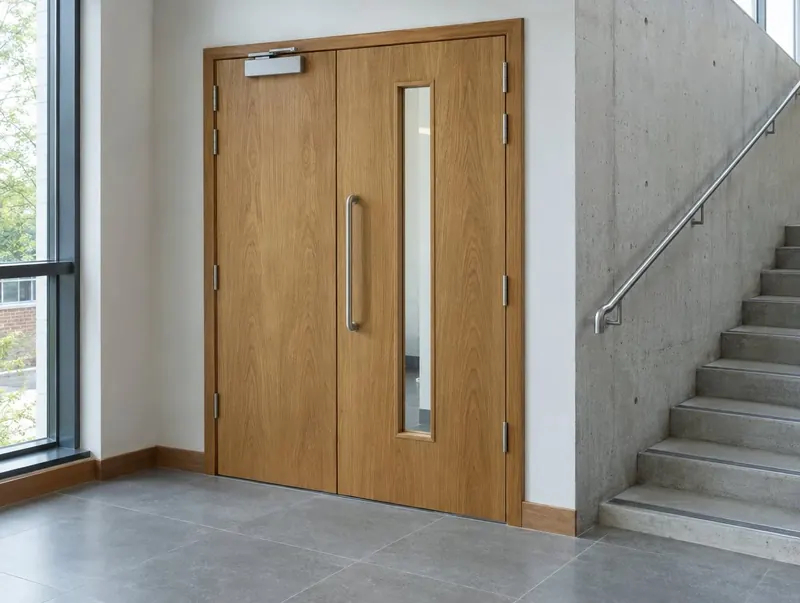
For new work, the fire strategy or Approved Document B (or the Scottish and NI equivalents) sets the rating of each door. For existing buildings, your fire risk assessment records what each door should be. A door generally needs to match the fire resistance of the wall it sits in.
Where FD30 is typical
- Protected corridors and lobbies
- Flat entrance doors (FD30S)
- HMO bedrooms and kitchens
- Most office and hotel doors
Where FD60 is typical
- Compartment walls between uses or occupancies
- Stair cores and firefighting shafts in taller buildings
- Plant, boiler and switch rooms
- Stores with a high fire load
What changes with FD60?
FD60 timber leaves are usually 54mm rather than 44mm, heavier, often with four hinges and stronger closers. Expect to pay roughly £1,050–£1,650 for a single FD60 doorset fitted, ex VAT, against £750–£1,150 for FD30.
Common questions
Can I fit FD60 where FD30 is required?
Yes, but it costs more and is heavier, so it's usually only worth it where you want a margin or expect the requirement to rise.
Is FD30 enough for a flat front door?
Usually FD30S is the requirement — 30 minutes plus smoke control.
Doorsets mentioned in this guide
FD30 Fire Doorsets
30-minute certified doorsets — the workhorse of flats, offices and HMOs.
View doorsets
FD60 Fire Doorsets
60-minute doorsets for compartment walls, stair cores and higher-risk rooms.
View doorsets
FD90 & FD120 Doorsets
90 and 120-minute doorsets, usually steel, for the highest-risk compartments.
View doorsetsMore guides
- How much does a fire door cost to supply and fit in 2026?
- Who is responsible for flat front fire doors?
- BS 476 is leaving Approved Document B: what changes for fire doors?
- Glass in fire doors: what's allowed?
- Repair or replace: can a fire door be fixed?
- BS 8214:2026: what the new fire door code of practice changes
- Do you need fire doors for a loft conversion?
- Fire door requirements for HMOs